6 Beauty Products I’d Actually Share—With a Few Ground Rules
I am not passing around my mascara, lipstick or makeup sponge. But perfume? A pump bottle of lotion? That is a different conversation. When a product can be borrowed without touching what remains inside, I become considerably more relaxed about sharing.

- The easiest beauty products to share are those that can be sprayed, pumped or dispensed without touching the contents.
- Personal brushes, sponges and applicators should stay personal—even when the product itself can be shared more hygienically.
- If someone has an eye, skin, nail or scalp infection, this is not the moment to start swapping beauty products or tools.
There is a particular kind of optimism involved in getting ready at someone else’s house.
You bring the dress. You remember the shoes. Somehow the mascara, setting spray or hair product you actually need is sitting safely at home.
Then comes the inevitable:
Can I borrow yours?
Sometimes my answer is an immediate no. We already covered those in our list of seven beauty products I would rather buy for a friend than share.
But I also do not think every object on a dressing table needs to be treated as though it belongs in a laboratory.
The FDA takes the cautious position that cosmetics should not be shared because microorganisms can move between users. Dermatologists similarly warn that shared makeup, brushes and applicators can transfer oil, dead skin cells and microorganisms—and may spread contagious problems such as cold sores or pink eye.
So my own rule is simple:
If I can give you some without you touching the product that remains, I am far more comfortable sharing it.
Here are six examples.
1. Perfume in a Spray Bottle
This is probably the easiest yes on the list.
You press the atomiser, fragrance comes out, and neither person needs to touch the liquid inside the bottle.
I would happily lend someone my perfume for the evening.
What I would not do is press the nozzle directly against someone’s skin or allow a roll-on fragrance to make the rounds. Once an applicator repeatedly touches skin and returns to the product, we have changed the equation.
My rule: spray bottle, yes. Shared roll-on, no thanks.
2. Lotion or Skincare From a Pump
Packaging makes a tremendous difference.
A pump bottle lets you dispense moisturiser, body lotion or another product into someone’s clean hand without dipping fingers into the container—or letting the nozzle touch the hand.
That matters because FDA notes that dipping fingers into cosmetics introduces microorganisms such as bacteria and fungi, and specifically recommends washing your hands before using products that require finger contact with the contents.
A jar is different.
If I wanted to share a jarred moisturiser, I would scoop some out with a clean spatula and put it onto a clean surface or into the other person’s hand.
I would not put the jar between us and say, “Dig in.”
3. Foundation From a Pump Bottle
This is where our previous article’s distinction between the makeup and the applicator becomes useful.
I would not share my foundation brush or damp beauty sponge. The American Academy of Dermatology explicitly recommends keeping makeup brushes personal and washing them every seven to 10 days.
But a foundation bottle with a pump?
Dispense a little onto a clean palette, tissue or other suitable clean surface without touching the nozzle, and your friend can apply it with her own clean tool.
That is very different from handing over an open pot of cream foundation or the sponge you used that morning.
Sometimes it is not the formula that determines how comfortable I am sharing. It is the packaging.
4. Setting Spray
Setting spray is another product I would generally be comfortable lending because the contents can be dispensed without an applicator touching the face and then returning to the bottle.
Keep a little distance between the nozzle and the face, follow the manufacturer’s directions, and avoid touching the spray opening with fingers or skin.
And I would apply one obvious exception: if someone has a contagious eye or skin condition, I would simply skip the communal beauty routine altogether.
That may sound excessively cautious until you remember that the FDA’s general advice remains not to share cosmetics in the first place.
5. A Hair Dryer, Straightener or Curling Iron
Here I become considerably less worried.
A hair dryer does not repeatedly dip into a cosmetic product or touch your eyes and lips. A clean straightener or curling iron is also quite different from sharing a hairbrush, comb or anything that has accumulated hair and scalp debris.
I would check that the styling tool is clean and in good working order, then borrow it without much drama.
If someone has an active scalp infection or head lice, however, I would put the communal hair routine on hold. The CDC specifically advises against sharing combs and brushes when head lice are involved.
And I would skip the old advice to wipe electrical styling tools indiscriminately with an “antibacterial cloth.” Different appliances have different finishes and electrical components. Unplug them, let heated tools cool completely and clean them according to the manufacturer’s instructions.
6. Nail Polish—With One Important Qualification
This one requires more judgment than perfume.
A bottle of polish is not the same thing as a pair of cuticle nippers, nail clippers or a file. Those tools contact the nail and surrounding skin directly; CDC recommends cleaning nail-grooming tools before use and sterilising shared tools in commercial settings.
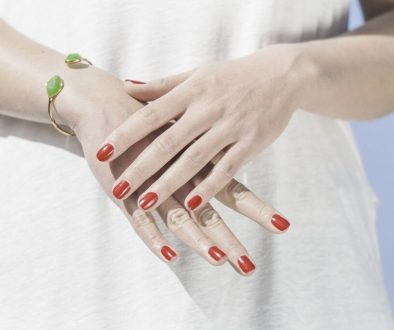
If somebody wants to try my favourite red, I am considerably less concerned about passing over the polish bottle than I am about sharing the manicure tools.
But if there is a suspected fungal infection, damaged nail, bleeding around the cuticle or another obvious problem, I would not share either.
And I would definitely keep the manicure tools separate.
There is also no need to wipe the polish brush with alcohol before returning it to the bottle, as our old article suggested. Introducing an unapproved substance into a cosmetic is not a hygiene practice I would recommend.
The Product Matters Less Than How You Share It
That is the part I think the old version of this article missed.
“Safe to share” and “never share” make wonderfully tidy headlines. Actual bathrooms and makeup bags are a little more complicated.
A pump bottle of foundation is different from an open jar.
A clean hair dryer is different from a mascara wand.
A perfume atomiser is different from a roll-on.
And a bottle of nail polish is different from cuticle nippers that may contact broken skin.
The FDA also recommends keeping cosmetics and their containers clean, closing them properly and storing them according to the manufacturer’s directions. Heat and damp conditions can encourage microbial growth or interfere with preservation.
What I Wish I’d Known Earlier: when someone asks to borrow a beauty product, I do not really need to memorise a list. I just ask whether we can get the product from the container to that person without their skin, fingers or personal applicator touching what remains inside.
That answers an awful lot of questions.
I still would not describe any shared cosmetic as completely risk-free—the FDA’s simplest advice is not to share them at all. But in real life, perfume sprays, pump bottles and other products that can be dispensed without direct contact are much easier to share hygienically than mascara, lip products or personal applicators. When in doubt, dispense rather than dip—and keep anything that touches eyes, lips or broken skin to yourself.